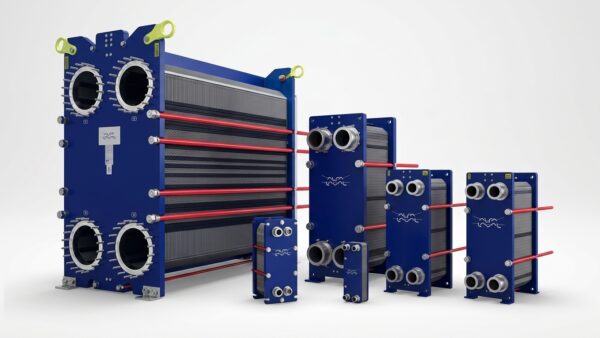
Brazed Plate Heat Exchangers
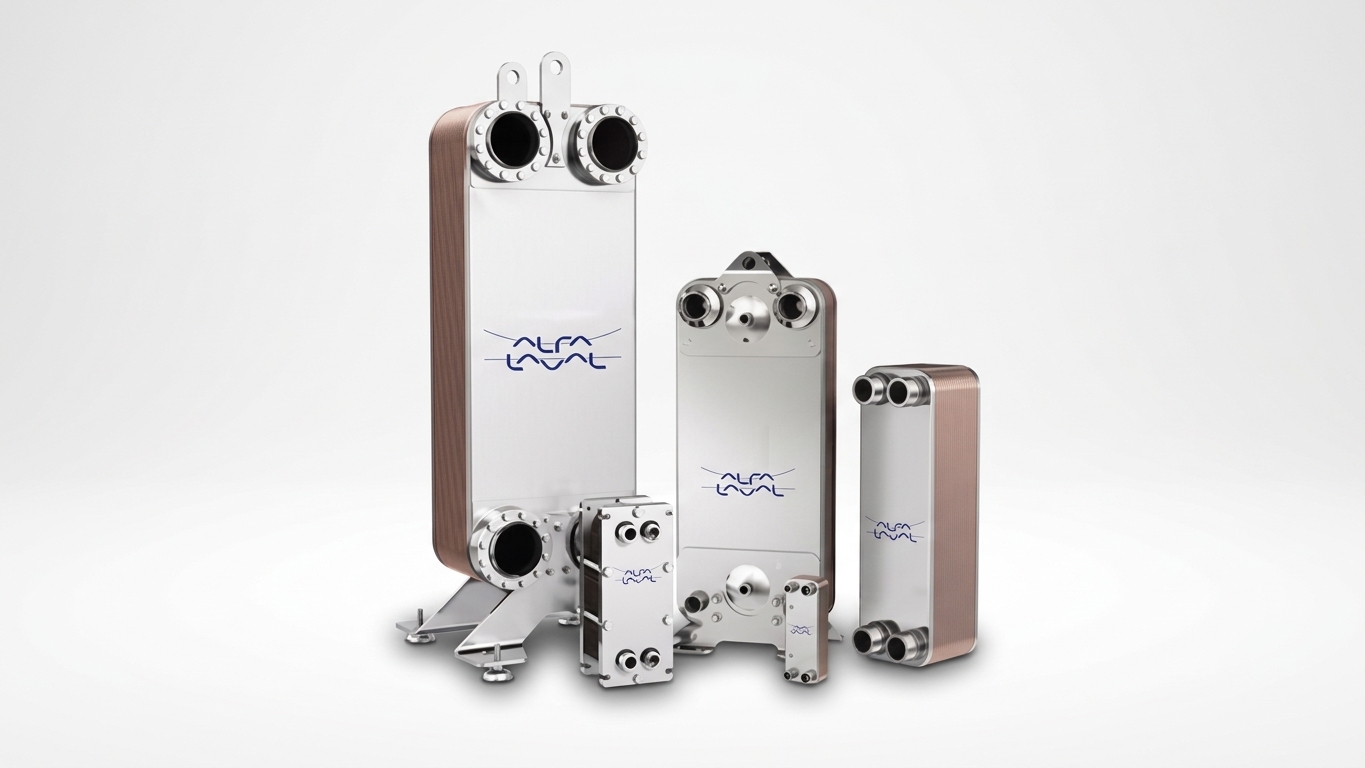
Discover our advanced range of copper-brazed plate heat exchangers, meticulously engineered by Stainless Connection to deliver exceptional thermal transfer efficiency within an ultra-compact, space-saving design.
Product Description
Key Benefits & Capabilities
• Maintenance-Free & Highly Durable: Our brazed plate heat exchangers are constructed without gaskets, ensuring an extended service life and eliminating the need for routine maintenance or resealing.
• Extreme Operating Thresholds: Designed and built to withstand exceptionally high working temperatures and extreme design pressures, providing reliable performance in demanding environments.
• Compact Footprint: We provide maximum heat transfer capacity while requiring minimal installation space, making them the ideal choice for modern, space-constrained plant layouts.
• Versatile Industrial Applications: Perfect for a wide array of industrial and HVAC duties, seamlessly handling cooling, heating, evaporation, and condensation processes.
Comprehensive Applications & Versatility
Brazed plate heat exchangers are widely utilized across modern refrigeration plants. They are primarily engineered to facilitate efficient heat transfer between a refrigerant (the primary fluid) and water or brine acting as the secondary fluid.
Our premium line of copper-brazed heat exchangers is primarily deployed in the following capacities:
• Evaporators: Optimized for dry expansion and efficient water cooling.
• Condensers: Designed for rejecting or recovering heat directly to water.
• Economizers: Excellent for cooling liquid refrigerant while simultaneously super-heating vapour refrigerant.
Additionally, our units can be effectively utilized as:
• Sub-coolers: To cool liquid refrigerants using well water.
• Intermediate Heat Exchangers: Applied in absorption cycles to preheat diluted solutions or pre-cool concentrated solutions.
How It Works
Brazed plate heat exchangers utilized for HVAC applications typically employ a parallel flow configuration to achieve the highest possible thermal transfer efficiency. Featuring a convenient single-pass design, all system connections are located on one side of the heat exchanger, ensuring streamlined and effortless installation.
Alternate Channel Pattern
When deployed as an evaporator, the intricate channels formed between the corrugated plates and corners are arranged so that the two media flow through alternate channels, consistently moving in opposite directions (counter-current flow). The two-phase refrigerant, consisting of both vapour and liquid, enters at the bottom left of the unit. The exact vapour quality depends directly on the operating conditions within your refrigeration plant.
Dry Expansion
The evaporation of the liquid phase takes place directly inside the channels. A specific degree of superheating is always required for this process, which is why it is formally referred to as “dry expansion.” The dark and light blue arrows clearly indicate the location of the refrigerant connections, while the water or brine to be cooled flows counter-currently in the opposite channel, with the dark and light red arrows highlighting the water/brine connection points.
Condenser Operation
When utilized as a condenser, the core structural components remain identical to those of the evaporator. The refrigerant enters the unit at the top left as a hot gas and immediately begins to condense across the surface of the channels. Once fully condensed, it undergoes a slight subcooling phase—a process known as “free condensation.” The dark and light blue arrows designate the brine connection locations, while the refrigerant flows counter-currently in the opposite channel to be efficiently cooled (indicated by the dark and light red arrows).